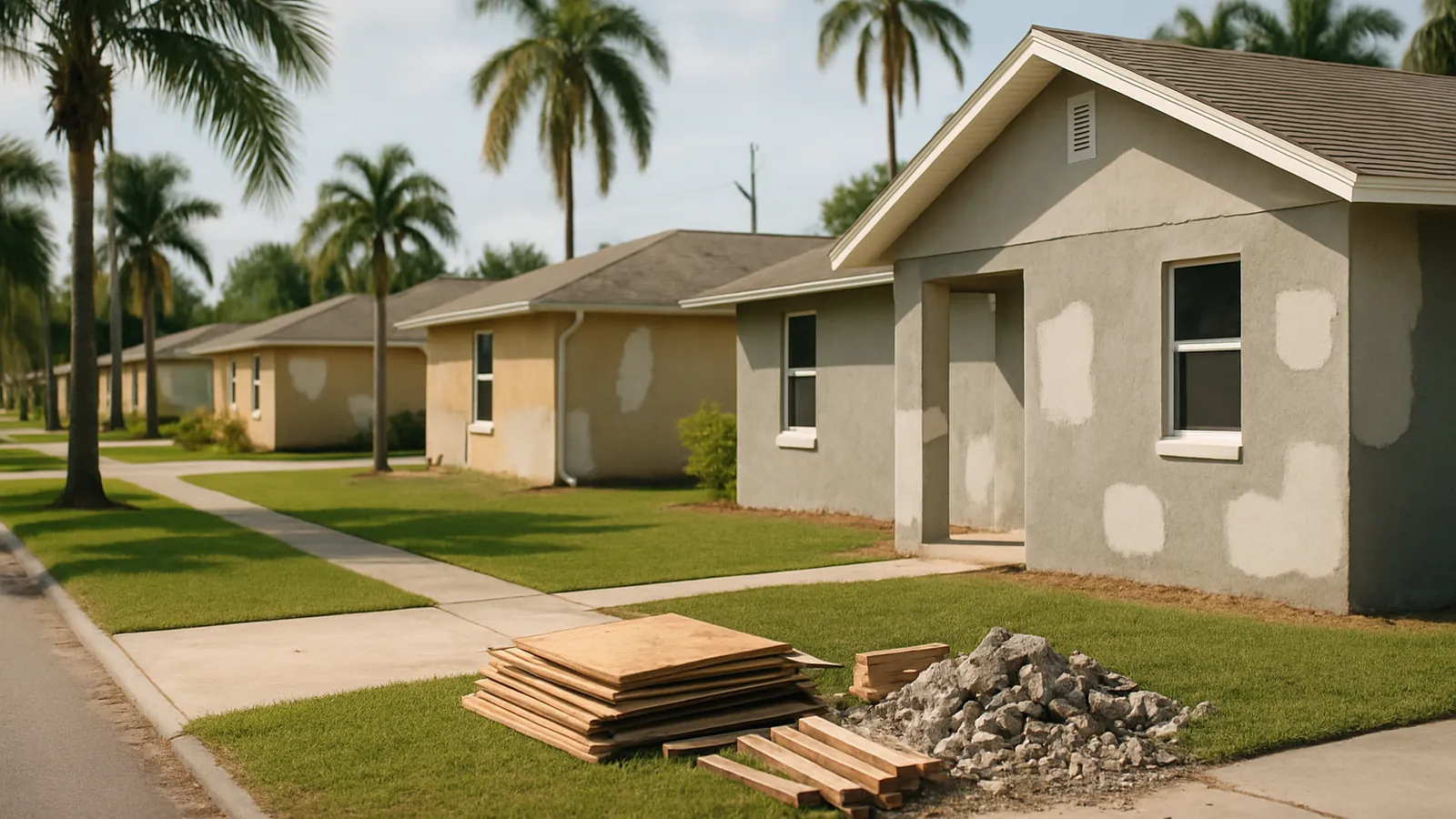
Mold removal in Mobile costs $1,500–$6,000 for most remediation and $6,000–$15,000 whole-home. Work runs under containment with HEPA filtration to IICRC S520, and the scope names the entry path — which here is frequently wind-driven rain rather than a plumbing failure.
The arithmetic behind Gulf rainfall, why an intermittent leak is a real leak, and the one line that predicts recurrence.
67 inches, and fewer than sixty days to deliver it
Mobile records 67.1 inches of rain in an average year — more than any other major city in the United States — across roughly 59 rainy days. Divide one by the other and the number that matters appears: better than an inch and a quarter on a typical rain day.
That is a fundamentally different loading than a rainy climate that drizzles. Rain here arrives in volume, at speed, and frequently at an angle, pushed by squall lines and tropical bands. Wall assemblies, window perimeters, and roof-to-wall intersections are designed to shed water running downward. Water arriving sideways under pressure finds paths that vertical rain never tests.

Why your leak is intermittent
Homeowners describe this constantly and doubt themselves for it: the stain appears after some storms and not others, and a plumber finds nothing. That pattern is not confusion. It is a directional leak, and it reports the wind as much as the rain.
Which is why a good inspection asks a question most do not: which direction did the weather come from when you saw it? A leak that only opens on a south wall during a southerly blow narrows the search to a handful of details on one elevation — head flashing, window perimeters, a siding lap, a wall-to-roof intersection. It also explains why a garden hose on a calm afternoon fails to reproduce it, and why a contractor who tried that concluded there was no leak.
Six stages, in the order they happen
| Stage | On site | The point of it |
|---|---|---|
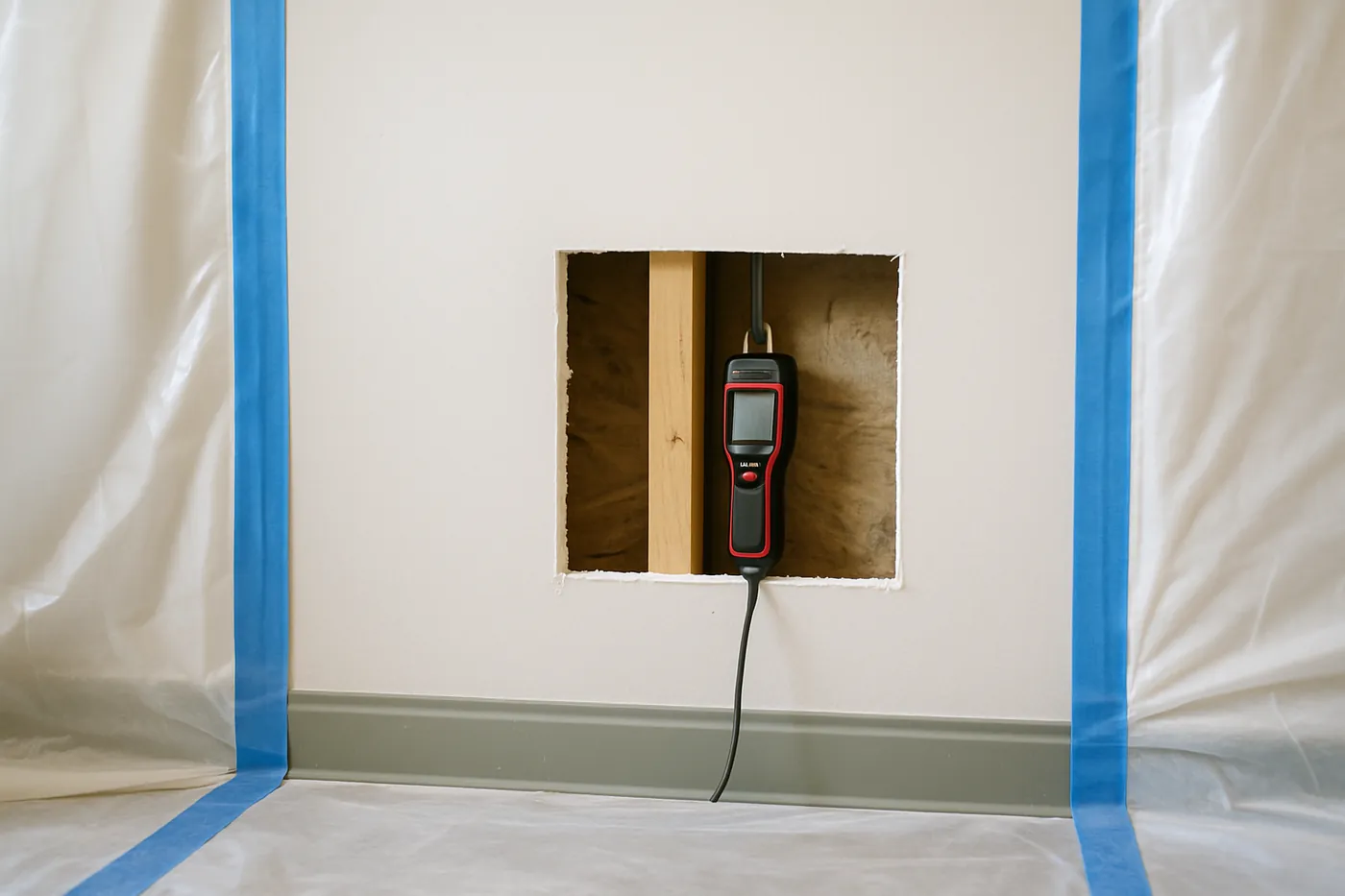
| Reading the house | Meters on material, cavity values, growth mapped, plus the weather history | Sizes the job and locates the way in |
| Sealing off | Barrier up, openings taped, air pulled negative through HEPA | The rest of the house does not inherit the problem |
| Demolition | Colonized porous stock leaves; dense surfaces get treated in place | Board and batt cannot be cleaned convincingly — they hold it internally |
| Getting it dry | Everything brought to a recorded moisture value | Sealing a damp cavity restarts the entire thing behind new paint |
| Shutting the door | The flashing, sealant, or cladding detail — priced on its own | Without it, the next system that comes ashore repeats this |
| Proving it | Final readings, written down, handed over | You leave with evidence rather than a reassurance |
One sentence separates the good bids
Go through every proposal hunting for a statement of how the water got in. “Demolish and treat affected board, south bedroom” is a description of manual labor. “Pattern consistent with driven rain at the south window head, cavity elevated at the header” is somebody telling you what they concluded and why.
Only the second one carries any information about next September. When a proposal lacks it, request it before you look at the totals at all — a contractor who took the growth out and a contractor who worked out where it came from produce documents that read very differently. Every figure appears in the cost guide.
Where it starts on a Gulf Coast house
- Window and door heads on the elevation that faces the weather
- Wall-to-roof intersections where a lower roof meets a taller wall
- Behind impermeable wallcoverings on air-conditioned exterior walls
- Around supply registers and duct boots that sweat in summer
- Framing under the house, which never gets a dry month
- Roof decking where a fastener or flashing detail opens under wind
Remediation, answered plainly
What does mold removal cost in Mobile?
Most remediation runs $1,500-$6,000, with whole-home or structural work $6,000-$15,000. The size of the affected area sets the base, and the entry path sets whether you do it again. A scope that removes growth without identifying how water got into the assembly is priced for half the job.
Why does the leak only show up sometimes?
Because it is probably wind-driven. Mobile takes 67.1 inches of rain across only about 59 rain days, much of it in squalls and tropical bands that push water horizontally. An assembly that sheds vertical rain can leak when rain is driven against it, which is why the stain tracks storm direction rather than rainfall totals.
Which written standard should the work follow?
IICRC S520, and it should be named in the scope. Alabama issues no mold-specific license, so the standard a company works to, and whether it will commit to it in writing, is one of the few things a homeowner can actually verify before hiring.
What gets removed and what gets cleaned?
Porous material that has been colonized comes out - drywall, insulation, carpet pad, ceiling tile - because growth extends into the material rather than sitting on the surface. Framing, concrete, metal, and finished wood are cleaned and dried in place and documented to a moisture content.
How long does it take?
Two to five days for a typical job: containment and negative air first, removal and cleaning through the middle, then drying and verification. Where the entry path is an exterior assembly, the repair that closes it may involve another trade and is scoped separately so you can see both halves.
Get a Mobile mold inspection
Describe what you have found — a stain that appears only after a hard blow, a room that smells musty every August, dark growth behind furniture on an outside wall, a ceiling mark that showed up after a storm. Two details help most: which wall, and whether it tracks the weather. A local specialist serving Mobile calls you back.