
Mold removal in Mobile costs $1,500–$6,000 for most remediation and $2,500–$9,000 under the house. The city takes 67.1 inches of rain across about 59 rain days, so intrusion here is high-intensity and often wind-driven. Many local specialists don't charge for the inspection; ask when they call.
The arithmetic that explains your intermittent leak, the summer mechanism that needs no leak at all, and what a scope has to name.
Do the division
Mobile records 67.1 inches of rain in an average year, the highest of any major city in the United States, and it does it in roughly 59 rainy days. That works out to better than an inch and a quarter on a typical rain day — several times the per-event loading of the cities people think of as rainy.
Rain here does not fall so much as arrive. It comes in volume, at speed, and frequently at an angle, driven by squall lines and tropical bands. Building assemblies are detailed to shed water running downward. Water arriving horizontally under pressure tests joints that vertical rain never reaches, which is the single most useful thing to understand about houses on this coast.
That is why your leak is intermittent
Homeowners tell us this constantly and half-apologize for it: the stain comes back after some storms and not others, and the plumber found nothing. That is not a confused observation. It is a directional leak reporting the wind as much as the rain.
So a good inspection asks something most do not — which way was the weather coming from? A leak that opens only during a southerly blow is a detail on the south elevation, and that turns a whole-house search into a few square feet. It also explains why a garden hose on a calm afternoon proved nothing: that test runs water downward, which is exactly the loading the assembly was built to handle.
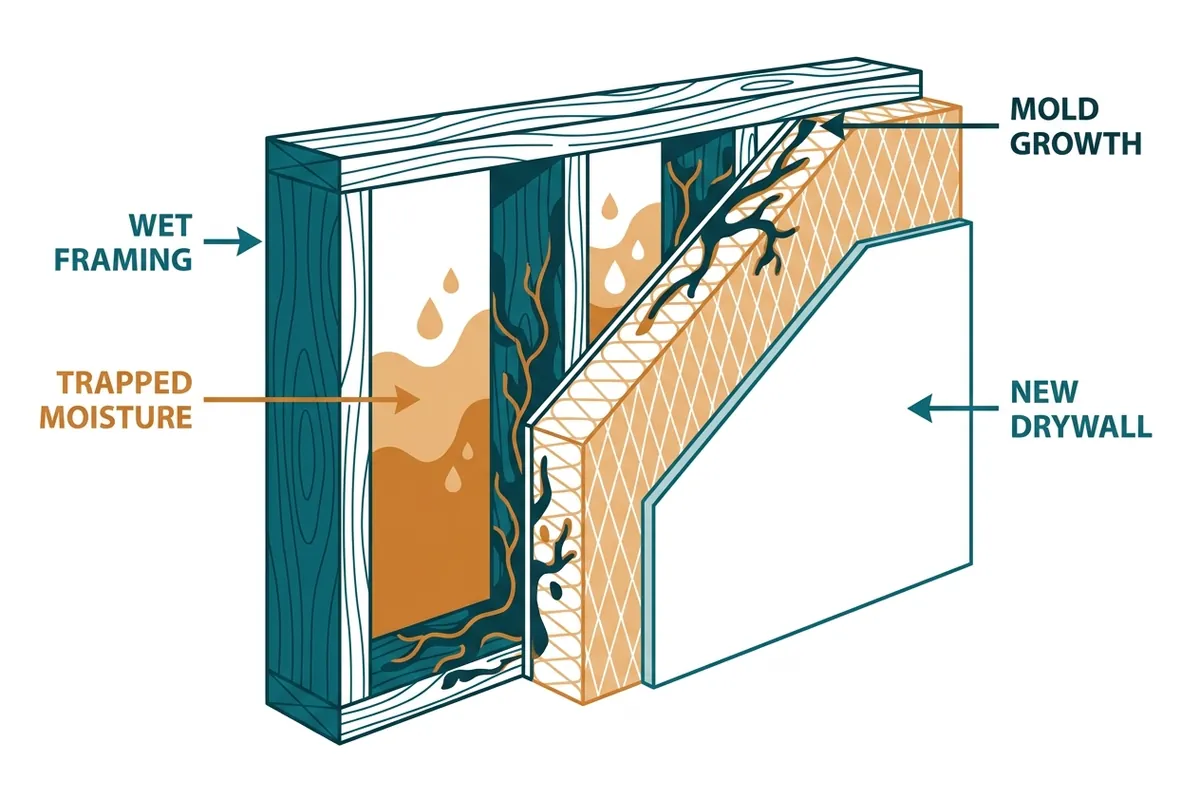
The other mechanism needs no leak at all
Relative humidity here runs about 71% in April to 77% in July, and August is the wettest month. In that climate your air conditioner spends the entire summer doing something worth naming: manufacturing cold surfaces inside the building.
Humid air that reaches one of those surfaces condenses on it. Behind an impermeable wallcovering on an air-conditioned exterior wall. Around a duct boot. On the inboard face of a wall that outdoor air has infiltrated. No pipe, no roof, no storm — just warm wet air meeting something the system chilled. It is the opposite of a cold-climate condensation problem and it is why houses here grow things in July.
What to do about it
| What you found | What it usually means | The work | Typical range |
|---|---|---|---|
| A stain that returns after certain storms | Wind-driven intrusion on one elevation | Remediation plus entry-path repair | $1,500–$6,000 |
| Musty smell rising through the floor | Framing under the house never dries | Under-house work | $2,500–$9,000 |
| Wet spot on a ceiling in July | Often duct insulation, not the roof | Attic and duct correction | $1,500–$5,000 |
| House is cold but clammy | Cooling without dehumidifying | System sizing and runtime | $1,000–$4,000 |
| Standing water after a storm | A 24-to-48-hour clock, already running | Emergency drying and flood cuts | $1,000–$8,000 |
| Dark growth and an alarming quote | Vocabulary doing the scope's job | Read the scope instead | Same as any job that size |
The Mobile cost guide pulls each of those bands apart and explains what pushes a house toward one end or the other — the small jobs included, the ones where the whole answer is a torn piece of duct wrap.
A quote here has two halves
Remediation removes what grew. Closing the entry path stops it growing back — and on this coast that repair is frequently an exterior detail belonging to a roofer, a glazier, or a siding contractor rather than to the mold specialist.
Which creates the most common unfair comparison in this market. One bid prices removal only. Another prices removal plus the repair. The second looks expensive and is usually cheaper, because the first one is scheduled to happen again. Ask every company, in plain words, whether the entry-path repair is inside their number or outside it.
What we won’t recommend
- Remediation with no entry path named. That is a removal with a return date attached.
- A hose test on a calm day as proof there is no leak. It reproduces the wrong loading.
- Opening the windows to dry a wet room. Outdoor air here is frequently no drier than indoor air.
- Attic ventilation as a moisture cure. The air you would bring in is near saturation itself.
- Paying a lab to tell you whether to demolish a stained wall. It comes out the same regardless of the answer.
Three questions get their own pages: what to check when a crew knocks after a named storm, why an oversized air conditioner leaves a house cold and clammy, and how wind-driven rain and flood split a Gulf Coast claim in two.
Mold questions Mobile homeowners ask
How much does mold removal cost in Mobile?
Plan on $1,500 to $6,000 for a standard remediation. Work below the floor runs $2,500 to $9,000. Attics come in at $1,500 to $5,000, duct systems at $1,000 to $4,000, and drying a storm-hit house at $1,000 to $8,000. Whole-house and structural jobs reach $6,000 to $15,000. Working out which one you need is what the inspection is for.
Why is mold so common in Mobile?
Two things stack. Mobile records 67.1 inches of rain a year, more than any other major US city, across only about 59 rain days - so it arrives hard and often sideways. And humidity holds near 71 to 77 percent year-round, so nothing gets a proper drying season.
My leak only shows up sometimes. Is that normal?
It is the signature of wind-driven intrusion, and it is real rather than imagined. Rain pushed horizontally against a wall tests details that vertical rain never touches, and only when the wind is from the right quarter. Which direction the weather came from is the most useful thing you can tell us.
Can mold grow without a leak here?
Routinely. With outdoor dew points high for months, your air conditioner is manufacturing cold surfaces inside the building all summer. Humid air reaching one of them condenses on it - behind an impermeable wallcovering, around a duct boot, on the inboard face of an exterior wall - with no plumbing involved.
Do I need testing before removal?
Generally no. A stained wall gets handled identically whatever the lab says, so you would be buying a fact you cannot act on. Worth the money in three situations: an argument you expect to lose without paper, symptoms a doctor is asking about, or a smell with no visible source. Those go to a hygienist, not to the company doing the work.
Will insurance cover it?
When water arrived through a covered loss - including wind-driven rain through a storm-created opening - often yes, subject to a mold sublimit and, after a named storm, a percentage deductible. Water that rose from the ground is flood and needs separate coverage.
Mold removal across Mobile and Baldwin counties
DaphneFairhopeSpanish FortSaralandTheodoreSemmesTillmans CornerSatsumaPrichard all service areas
Get a Mobile mold inspection
Describe what you have found — a stain that appears only after a hard blow, a room that smells musty every August, dark growth behind furniture on an outside wall, a ceiling mark that showed up after a storm. Two details help most: which wall, and whether it tracks the weather. A local specialist serving Mobile calls you back.